This is my first time noticing one of their posts, but to me it evokes the ideals of the Long Now Foundation, putting our thoughts in a future-forward stance.
Do you know if those characters are in supplemental planes? The BMP would only be glyphs from U+0000 through U+FFFF (though the first 32 and last two aren't printable, and wouldn't be included in this font).
Another example would be emoji, which would probably now be considered "basic" by most people but have always been in a supplemental plane.
Yes that section raised my hackles too, to the point where I'm suspicious of the whole article.
The solution, in my opinion, is to either document that strclone()'s return should be free()'d, or alternately add a strfree() declaration to the header (which might just be `#define strfree(x) free(x)`).
Adding a `char **out` arg does not, in my opinion, document that the pointer should be free()'d.
Yeah, at the least you'll need an understanding of ULPs[0] before you can write code that's safe in this way. And understanding ULPs means understanding that no single constant is going to be applicable across the FLT or DBL range.
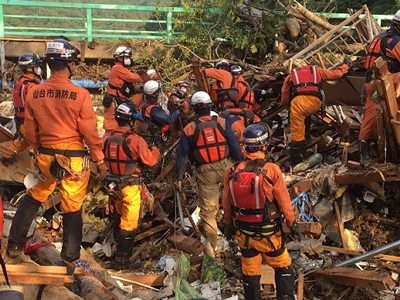
The reference is that the anime character "Naruto"[0] wears the same colors and roughly the same uniform as a Japanese recovery worker[1].
During disaster work, you see swarms of recovery workers and the joke/reference being made is that this looks like Naruto doing a "shadow clone" technique.
There was strong cultural pressure to be able to write perl in as few bytes as possible, ideally as a CLI one-liner. Books[1] were written on the topic.
> There was strong cultural pressure to be able to write perl in as few bytes as possible
Hard disagree. Many Perl programmers enjoyed engaging in code golf (always just for fun, in my experience), but in my nearly 30 years of programming Perl, I never encountered anything that I would call pressure to do so -- not from anyone.
One-liners is one of the ways you can use perl. You can also use it as the embedded language in some larger project. As perl CGI. As mod_perl. etc. There is no "cultural pressure" to use any of these. You can choose to mess around with one-liners and you can choose to spend time shaving a few characters off your code. Or not. None of this is the one true way. This is not python.
Specifically, after 133_076_755_768 steps, the 1-dimensional pattern reoccurs translated by two pixels. On skimming the thread I haven't determined if that shift is parallel or perpendicular to the line.