> I recall years of hints that the affordable housing crunch would eventually be helped by developers - even tho they're only building tons of not-affordable housing.
If I may ask, what cities? For example, Austin has seen a 6.6% asking price decrease for 0- to 2-bedroom units [1]. The big problem is there is an absolutely massive hole, and very few places are building "enough" to make a dent.
> The "industrialisation" concept is an analogy to emphasize how the costs of production are plummeting. Don't get hung up pointing out how one aspect of software doesn't match the analogy.
Are they, though? I am not aware of any indicators that software costs are precipitously declining. At least as far as I know, we aren't seeing complements of software developers (PMs, sales, other adjacent roles) growing rapidly indicating a corresponding supply increase. We aren't seeing companies like mcirosoft or salesforce or atlassian or any major software company reduce prices due to supply glut.
So what are the indicators (beyond blog posts) this is having a macro effect?
> But no one wants to hold them because they devalue and will continue to do so at an accelerating rate.
Devalue against what is the main question though, isn't it? The real longer term issue is that the USD is devaluing against the Euro, but even that has serious issues for Europe's export oriented economies [1].
> Devalue against what is the main question though, isn't it? The real longer term issue is that the USD is devaluing against the Euro...
I don't think that FOREX rates are the best way to think about this, but if you work in that world or otherwise have an intuition for it, then go ahead.
Most of us only handle 1 currency, and reasoning in terms of 2 isn't exactly an intuition pump.
Instead think about:
1. The dollar valued against itself a year earlier, and a year in the future. That is the interest rate or yield of the asset if held.
It should have a positive real yield, but right now it doesn't.
2. How much your personal basket of monthly expenses costs in terms of dollars.
Ignore a basket that someone on the news told you to care about, like CPI.
I mean your personal basket, all the stuff you personally buy, how much is it in dollars, now, a year in the future, a year earlier.
If you stored value in business or a precious metals in the last year and then converted back, you would probably have more dollars, or be able to buy more stuff, that's all there is to it.
> I don't think that FOREX rates are the best way to think about this, but if you work in that world or otherwise have an intuition for it, then go ahead. Most of us only handle 1 currency, and reasoning in terms of 2 isn't exactly an intuition pump.
Forex rates, balance of trade, and relative strengthening are great ways of understanding international fluctuations. They are exactly the way to understand reserve currency movements
> 2. How much your personal basket of monthly expenses costs in terms of dollars. Ignore a basket that someone on the news told you to care about, like CPI. I mean your personal basket, all the stuff you personally buy, how much is it in dollars, now, a year in the future, a year earlier.
This hits at a major part of the issue: goods that have no importable replacement good (housing and healthcare, namely) are a huge part of what lead to the huge bout of inflation. But those are domestic economics, not international economics.
>The dollar valued against itself a year earlier, and a year in the future. That is the interest rate or yield of the asset if held. It should go up, but right now it goes down.
It depends.
Positive real interest rates do not necessarily mean deflation, and deflation isn't necessarily a bad thing.
As an example, you could give a loan for $1 to someone for 5% interest.
In a year they pay you back, so now you have $1.05.
That dollar could get you exactly the same amount (of real goods or services that you personally want) as last year, or it could get you more, or it could get you less.
Inflation and deflation typically refer to the price of a basket of intrinsically valuable goods and services.
That is separate from the interest rate which is just what you, the creditor, and the debtor shake hands over.
If the dollar gets you the same basket as last year, then you are net better off because now you can buy the basket and you have $0.05 for lending to someone who was able to pay you back.
The missing variable here is the productivity of the rest of the economy, if the economy is growing, then you can see a decrease in dollars per basket (deflation), but that's not necessarily a bad thing.
The interest rate is sort of like a best guess for the productivity of the debtor.
The EUR/USD FX rate has been pretty stable for about 10 years. I think (sadly, didn't check notes before I wrote this), the trade balance between US and EU is well-balanced. As a result, the FX rate should also be well balanced.
> Hum... There are no reliable numbers out there, but I don't think the dollar devaluation has been keeping up with the US inflation.
There isn't anything like "dollar devaluation has been keeping up with the US inflation". You are interested in what is called the import/export price index [1] and for imports that has been relatively flat for the past ~24 months(import +.3%, export +3.8% for TTM). So in a sense, imports for a fixed good are relatively unchanged in constant-currency terms.
It's more along the lines of "if the EUR goes to 1.5, what does this do to eurozone economies?" and the answer to that isn't pretty for europe. This would greatly impair the economy of Germany and other large eurozone economies pretty substantially(see this article for why [2]).
And finally, remember: the US actually exports inflation [3]. Most economies cannot simply say no to this effect.
> If all the prices rise in the US to compensate, Europe stays exactly as competitive as before.
Yes, but my point is exactly the opposite has occurred for imports: the US is still roughly flat in terms of import inflation. Since Nov '22, import inflation has been sub-3% without exception and sub-2% since 2023 without exception. The US is still exporting inflation effectively, and US inflation is due to factors other than currency fluctuations.
That's the real issue: the USD weakened 8% against the EUR, and prices remain the same. For eurozone exporters to the US that's an absolute disaster.
What other choice is there? About 10% of all US healthcare spending is on end-of-life care [1]. It's not pleasant to talk about, but it is a discussion that needs to take place.
Speaking only of the financial aspect, not any other ethical issues:
Those end-of-life patients paid into the system, earlier in their lives, financing the cost of earlier generations of end-of-life patients. It would be unfair to change the social contract now.
In my opinion, it is no different from how adult taxpayers finance public education for children. It is a rolling responsibility from generation to generation.
You may be able to alleviate this financial issue (and not any other ethical issues) by phasing-in this policy change with the youngest generation of Medicare taxpayers, somehow.
> Those end-of-life patients were paying into the system, earlier in their lives, financing of the cost of earlier generations of end-of-life patients. It would be unfair to change the social contract now.
> In my opinion, it is no different from how adult taxpayers finance public education for children. It is a rolling responsibility from generation to generation.
This hits upon the core issue: the next generation is substantially smaller than the last and relative costs have ballooned due to greater availability of therapies. The generational contract is that you pay your taxes a percentage of wages -- in effect, a PAYG mechanism. If wages do not rise sufficiently to cover increased costs, that does not imply that the generational contract was unfulfilled; the taxes were paid.
The demographic pyramid and weaker than necessary wage growth really renders the care demanded burdensome to the point where we have already provided elderly cost advantages in insurance in the form of cost premium multiple maximums and medicare from payroll taxes while beggaring the rest of the population in the process.
> In my opinion, it is no different from how adult taxpayers finance public education for children. It is a rolling responsibility from generation to generation.
Fundamentally, children are an investment. They produce cash flow (taxes) from increased public health. The end-of-life are not; by definition, they will be dead soon. It's a horrible thing to say, but in the face of ever increasing elder care burdens and weak public debt/gdp ratios, what real choice is there?
> If wages do not rise sufficiently to cover increased costs, that does not imply that the generational contract was unfulfilled; the taxes were paid.
That's an interesting alternative view I had not considered. I think it is debatable. I believed the generational contract to be "healthcare for 65+ with 20% copay, etc., no gov. expense spared" whereas you argue the generational contract to be "Medicare payroll tax of X% is constant over all time; spend it wisely." I would argue the first option was the original intent of the Medicare law.
> Fundamentally, children are an investment. They produce cash flow (taxes) from increased public health. The end-of-life are not
You could argue the same for the end-of-life, in at least two ways:
* the end-of-life patient has already produced cash flow to the government, just in reverse order from the student
* Good education produces a higher taxpaying adult, the investment you refer to. I would argue the assurance of end-of-life healthcare also produces a higher taxpaying adult.
I acknowledge the costs have gone up faster than wages+population.
> I believed the generational contract to be "healthcare for 65+ with 20% copay, etc., no gov. expense spared" whereas you argue the generational contract to be "Medicare payroll tax of X% is constant over all time; spend it wisely." I would argue the first option was the original intent of the Medicare law.
I appreciate this view, but it is ahistorical and does not reflect the history of Medicare law.Taken from [1]:
> By the late 1970's, the growing expenditure trends and the changing demographics (an increasing proportion of the U.S. population 65 years of age or over) combined to endanger the solvency of the Medicare Trust Fund. The rapid increases in expenditures for the Medicare program, as well as health care services in general, constrained the ability of the Federal Government to fund other health and social programs. To a certain extent, the growth in expenditures also endangered the Nation's overall economic productivity.
> At the same time as health care expenditures were escalating, some say uncontrollably, the political landscape began to change dramatically. The national mood brought calls for fewer taxes, for reduction of budgets, and for deregulation of market sectors, such as transportation and health. This conviction of less general involvement by Government was reinforced by mounting public pressures surrounding growing budget deficits; Medicare, like other Federal programs, increasingly competed with more global policy objectives. In the space of a few years, the Nation moved from an era when health care was considered a right for all citizens to an era when cost considerations became the dominant issue.
And bear in mind, this was just ~10 years after Medicare was introduced. The nation has always prioritized the future over the past, and has either reduced or restructured benefits to ensure a healthy economy ahead of Medicare.
> You could argue the same for the end-of-life, in at least two ways: * the end-of-life patient has already produced cash flow to the government, just in reverse order from the student * Good education produces a higher taxpaying adult, the investment you refer to. I would argue the assurance of end-of-life healthcare also produces a higher taxpaying adult.
This lacks an understanding of Medicare. Medicare is fundamentally a PAYG mechanism; the trust fund was a short term surplus which is slated to be depleted by 2033 [2]: a mere 8 years from now. Part of this occurs due to poor investment strategy (treasuries only, effectively) but the biggest contributing part of this was the demographic boom. The time for "more cash flow to save for Medicare" isn't today it was 30 years ago. A failure to raise taxes 30 years ago should not constitute an obligation on the youth of today and placing the burden of an excessive tax because of poor demography and unwillingness of prior generations to raise taxes on themselves only harms economic growth at the expense of the elderly.
That's a reasonable question with several answers.
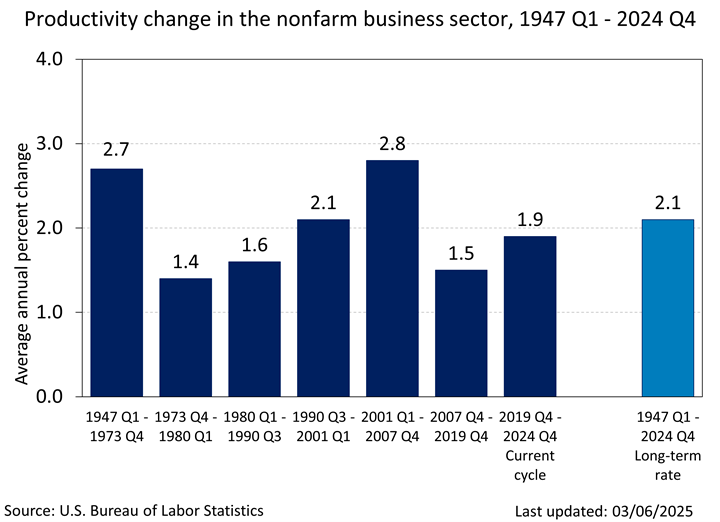
One is that US healthcare cost inflation is very high. The average family premium in 1999 was $6k, it is now $27k, for an annual cost increase of 6.1% per year. The long term rate of productivity increase is much lower than that, at only 2.1% per year.
So costs have just risen a lot more than productivity has.
Another reason is that productivity increases aren't evenly distributed. Most productivity growth has been in other sectors, primarily oil+gas and tech i.e. sectors dominated by men who aggressively automate. Healthcare has seen no increase in worker productivity for decades:
Output is up, but only because of more hours worked. And much of that output is growth of administrative overhead, not actual healthcare as most people perceive it.
Soaring demand + zero productivity growth + cost inflation 3x higher than inflation + no political will to control costs = a death spiral in which the lowest risk decide to go it alone and drop out, leaving ever higher premiums for the rest.
And productivity in society has gone up by huge amounts since the 1960s. Just since the 90s it's more than doubled, but going back to the 1960s it's much more than that. So you can't just say 'but population dropped'.
Fundamentally what is the purpose of society if the improvements it makes over time don't improve its's citizens lives? If even with tripling it's economic output it can't care for it's people (just because they are old doesn't make people not part of society)?
This argument is a moral event horizon and the problem should be resolved by other means.
Once one decides to ration healthcare based on estimated remaining QALY, the same logic says we shouldn’t subsidize, e.g., healthcare for people who suffer from cystic fibrosis, or HIV, or aggressive cancers, or. . .
Or if you’d rather, there are millions of children without healthcare in the United states. Would you forgo your access to healthcare for them?
> $365 billion of it went for end-of-life care. [1]
That’s all? Musk alone is worth twice that, and who knows how many QALYs he has left but it can’t be that many. He seems pretty miserable most of the time.
> Once one decides to ration healthcare based on estimated remaining QALY, the same logic says we shouldn’t subsidize, e.g., healthcare for people who suffer from cystic fibrosis, or HIV, or aggressive cancers, or. . .
Those are risks. Risks are insurable. However, death is a certainty. It is very reasonable to discuss what we believe society should subsidize for end-of-life care as it will impact everybody, myself included.
> Or if you’d rather, there are millions of children without healthcare in the United states. Would you forgo your access to healthcare for them?
I don't see what pediatrics has to do with end-of-life care in the context we are discussing (Medicare), but I would much rather subsidize pediatrics than elder care.
> That’s all? Musk alone is worth twice that, and who knows how many QALYs he has left but it can’t be that many. He seems pretty miserable most of the time.
Musk is worth 244B [1]. Even if we could tax wealth 100% into cash, we would fully exhaust the wealth of the 25 wealthiest American families within 7 years. These expenses, however, will likely continue for the next ~20 years. We need to discuss benefit cuts or tax hikes on the American population writ large.
> Once one decides to ration healthcare based on estimated remaining QALY, the same logic says we shouldn’t subsidize, e.g., healthcare for people who suffer from cystic fibrosis, or HIV, or aggressive cancers, or. . .
Not everybody gets cystic fibrosis, or HIV, or aggressive cancers. These are a risk. That is fundamentally an insurable risk. However, we will all die. No matter how much money is spent, death comes for us all in old age. Discussing how much is an appropriate cost for end-of-life care when aged is very much a societal question.
> Or if you’d rather, there are millions of children without healthcare in the United states. Would you forgo your access to healthcare for them?
This remains a question, even in Europe. See [1] for a discussion as early as 2000 regarding rationing in the NHS.
> That’s all? Musk alone is worth twice that, and who knows how many QALYs he has left but it can’t be that many. He seems pretty miserable most of the time.
That is a cost each year, and Musk is currently at 244B [2]. We have roughly 20 years of this level of spending or greater. Even if we assumed we could tax Musk 100% (which isn't practically possible because who liquidates his positions), where do you propose to acquire that level of ongoing cashflow? Within 7 years, we would fully exhaust the wealth of the 25 wealthiest American families, even at 100% tax rate. End-of-life care is mind-bogglingly expensive for the United States economy. This either needs to be a tax hike which realistically will it everybody or a benefits cut.
How did you get into construction/remodeling, and how would someone best reach out to this community? I have been thinking about some construction related ideas (mostly around prefab automation and sales) and haven't the slightest idea how to reach these types of people.
I am always curious about people who are strongly oriented towards one thing (computing) but somehow wind up in another area, such as construction.
When I was a sophomore in high school, I worked part time for my neighbor who was a master electrician. I learned the basics with him.
My parents divorced when I was 17 and we were forced to move away.
My mother was an assistant manager at the apartments we lived at. I turned 18 and just so happened the complex she worked at was hiring someone to do make readies, (painting and repairs on vacant units before new move-ins).
The management company my mother and I worked for sent me to various classes over the next several years (electrical, plumbing, HVAC and pool maintenance) and my supervisor was an old HVAC tech. I learned a ton from him.
By the time I was 22 or so, I was promoted to maintenance director.
I got bored with apartments and wanted more. I started doing side work and met a lady that owned lots of rental property. That opened doors and she introduced me to other investors. Eventually, I was able to leave the apartment industry and do my own thing.
It just kind of blew up from there.
As far as your construction related ideas, just put yourself out there. Meet people in the industry. Go to local industry related events. See if the city you live in has real estate investor clubs. DFW has a few and it's a great opportunity to meet people.
This is also a great way to pick up work. Rent houses are always needing things repaired or replaced.
I know Mueller metal buildings is always looking for sales people. They were even looking for an IT person not too long ago too. In the rural area of Texas I'm in, we finish out lots of them and seem to becoming more and more popular in recent years.
The market is pricing in significant counterparty risk. It's possible Oracle does the buying, unpacking, and cooling of Nvidia servers and doesn't get paid.
> It's possible Oracle does the buying, unpacking, and cooling of Nvidia servers and doesn't get paid.
The beauty of being a cloud infra provider is you're selling shovels. OpenAI going bust? Doesn't matter too much for Oracle, there will always be someone willing to pay them for GPU compute capacity.
Even if the hype behind AI dies down, which I hope it does rather sooner than later, the fundamental aspects aren't vaporware like with the cryptocurrency craze - AI, even the relatively lackluster state we have today, has a ton of very useful usage cases that are actually working in the field.
> AI, even the relatively lackluster state we have today, has a ton of very useful usage cases that are actually working in the field.
Useful use cases at what price? It's totally possible that after VC money dries up the price increases far beyond what customers (both business and consumer) have been paying, resulting in demand destruction rendering the investment a net negative for Oracle.
Not nessesarily. We have providers of hosted oss models (even large sota ones), with competitive API pricing. They have no reason to subsidice their services, outside og initial market grab. But there is so many of them that it dosent look to bad.
Also buisnisses have invested to host things locally themselves as well.
> Not nessesarily. We have providers of hosted oss models (even large sota ones), with competitive API pricing. They have no reason to subsidice their services, outside og initial market grab. But there is so many of them that it dosent look to bad.
That price is holding at the current demand ratio of GPU availability/consumption. If the large companies such as OpenAI and Anthropic cease training new models and accepting loss-leader lines of business such as free consumer inference there is a reasonable chance of a GPU glut. This GPU glut may drive down prices Oracle can command for their cloud services.
The fundamental problem is not the market as it stands today. The problem is where will the market equilibrium shift from increased capacity and reduced demand due to VC subsidy reduction.
That might be precisely why OpenAI is pushing an over investment in infrastructure. When VCs are no longer willing to substitute compute, having more compute available than natural demand will drive the prices down.
Their customer base rapidly disappeared and they tried to paper over the losses with accounting fraud where they had fake sales of equipment because their actual customers disappeared. They had tons of equipment to sell with few customers left to buy them.
There's about to be a huge glut of GPU capacity and we still haven't figured out anything to actually do with all those GPUs that creates value at the scale of society.
Everything they do now steals value. Takes it from artists and bloggers and puts their money in the hands of CEOs and investors. Super efficient idea theft isn't creating new value for society because the value gained is always offset by the destruction of value we already had...
> there will always be someone willing to pay them for GPU compute capacity.
There is an hourglass shape to emerging technologies. Everyone uses commodity hardware and duct tape to try to win the race to the bottleneck, where everyone save 2 companies goes bankrupt. As it narrows companies have learned enough about the problem to start developing purpose built solutions. Once you pass the bottleneck enough of your engineers go to other companies that the custom solution becomes mainstream and competition grows again.
Google was working on custom chips for AI before we knew it was AI. They are going to survive either as the dominant player in AI or as the underlying platform everyone else builds on.
That leaves one other spot for everyone else racing to the eye of the needle. Anyone betting on Oracle to win on technology is silly, betting on Oracle with a bunch of generic GPUs that anyone can get is down right dumb.
Problem is, those Nvidia servers are useless to anyone who needs servers already racked in a datacenter. They're purposely made purely to run LLMs, and anything else would be a waste of time.
Nvidia is also fucking over anyone who buy these: datacenters depend on used hardware sales to recoup cost, sometimes getting up to half of what they originally paid for the hardware.... this hardware has no resale value.
It's literally garbage the moment it leaves the factory.
> datacenters depend on used hardware sales to recoup cost
Who? Ive worked for few big infra companies with millions to billions of DC assets. After depreciation and then some, say 3-5 years, theyre effectively scrap. Its more cost effective to buy new, denser, racks than continue to MRC on the stranded space and power. The reseller is cheaper/easier effectively paid to scrap the parts as e-waste and recover what they can.
Datacenters hire companies to do this on their behalf, as they don't have the internal know-how to do this. Even the big cloud companies do this.
They're on 3-5 year cycles, yet the hardware life has a good 8 years in it. The reseller sifts through what comes out, sees what is still alive, scraps what isn't, and resells the rest.
What you don't understand is this isn't a one way relationship. If you're a major cloud company, your hardware probably already is worthless. Meta (and other companies) use a non-standard case and rack "standard" called Open Compute (OCP)... there is no resale market for these, as normal datacenters use normal racks with normal cases. Meta has to pay a company to dispose of these and lose 100% of their investment.
But lets say we go to someone else that does use standard hardware, and the rest of the industry buys this stuff up (to maintain existing fleets that don't need upgraded yet, not everybody is on some ridiculous 3-5 year churn), the company you partnered with to deal with your e-waste is likely to either give you a much better rate or even pay you for your hardware (if it is in high demand).
These enterprise inference machines have zero resale value. Even the OCP stuff I mentioned above has a small market (theres a few smaller datacenters out there toying with OCP due to it having better density, but aren't willing to buy new to test it out), but there is no market for these inference SBCs.
See my sibling comment to this for more information on why the SBCs are uniquely weird.
Maybe i read too much in to “depend on used hardware sales.” Ive worked for 2/5 and 3/15 largest us companies doing cloud and infra stuff. Recovered costs from EOL hardware has just never ever mattered. Not even a rounding error on P&L and hardware/dc org has 1000 higher value priorities. Ill admit maybe the offset costs were squirreled away in finance but not visible to the business.
Even with zero resale value thats “fine.” Anytime Ive owned capacity planning it’d be more cost effective to pay someone a multiple of rack MRC to get the hardware out and free up the space and whips. The impediment was almost always free hands and coordination functions that were being spent on new adds rather than replacement.
E-waste disposal is a huge cost, and it might be entirely possible you're not seeing the cost, or you're not aware of what a badly negotiated contract looks like.
Also, a lot of the industry runs on incredibly poor margins. The only datacenter space in the world right now printing money is either owned by clouds or owned by the AI bubble (which are sometimes the same companies, or the cloud leasing space to the AI bubble).
Mostly, profits are eaten by power deals (this is why Facebook put their biggest important DCs up where the cheapest power in the US is) or property ownership (buying land, building the DC, paying property taxes, maintaining the building, etc, that shit aint cheap), and then you get to buy hardware and hopefully get customers.
Amazon, Google, Facebook, et al all cheat their way through every loophole known to man to keep the costs down and the profit high; not a lot of it is from scale, even though they're still trying to chase that to the end, too.
They're not GPUs in computers... they're effectively GPUs that are computers. They're a single board computer (SBC), with an ARM CPU that is approximately the scale for desktop but not the scale for enterprise, conjoined with 2 extremely large GPUs that are siblings to the desktop version.
Each GPU chip is approximately twice the size of the biggest desktop version, and it has two of them, and it roughly twice as dense as anything else you could do using normal enterprise-dense GPU deployments (ie, those rigs that have 4 x16 slots and fit dual-slot GPUs across 8 slots)
However, these are not the same chips, they are siblings: the major change is, depending on the generation, they contain 2x or 4x matrix math ALUs and no texture units.
Seeing as it is a "small" (for enterprise) CPU, and a GPU that is very poor at non-matrix GPU tasks; and since it doesn't have TUs or media controllers (thats the thing that does DP/HDMI and video decoding/encoding) it can't be some weird niche desktop.
Unless you're doing inference at home, this thing is useless. Inference at home, and even small scale enterprise inference, is very very niche. There isn't enough market to give these boards a second chance.
However, totally normal used server parts? Totally useful. Cases, fans, power supplies, motherboards, CPUs, RAM, HBA/RAID, NICs? All useful to end users, either smaller companies doing inexpensive onsite, smaller datacenters maintaining an existing fleet and not needing to upgrade yet, or people building home labs.
It's very rare that you'll be at the exact point where it does make sense to use the "not quite high-power GPU racks".
* Lowest short term costs favors "just use the Cloud" solutions, that will often have power, HVAC and space constraints that favors new GPUs.
* Lowest long term costs bias the cost analysis to OPEX, where old GPUs gets expensive very fast, as they use more power, HVAC and space for less compute.
> Governments can issue muni bonds to build housing if private developers will not or cannot, and use eminent domain to acquire rental real estate not being maintained to living standards codified in statue.
With what money? LA was recently downgraded [1] and adding poor people who need social care harms not helps the city budget.
Roughly 80% of developed water use in SoCal is agriculture. Population is a secondary concern when it comes to water use in the area. Severance of riparian rights through eminent domain is looking increasingly appealing.
Worse, now device manufacturers can now make their devices identify as "apple" out of the box and advertise it as "compatibility with Apple AirPods features X, Y, X" and be legally permissible.
It's basically the consequence Google v. Oracle and the cases leading to it.


If I may ask, what cities? For example, Austin has seen a 6.6% asking price decrease for 0- to 2-bedroom units [1]. The big problem is there is an absolutely massive hole, and very few places are building "enough" to make a dent.
[1] https://www.realtor.com/advice/hyperlocal/austin-rents-are-g...
reply