Given that they've been in continuous use for centuries I question the conclusion that they're not effective, but I'm open to altering my opinion backed-up with data.
> Bear bells may be a popular item to put on your backpack, but they don’t effectively warn a bear you’re in the area. Bears won’t hear the bells until you’re too close. Yelling, clapping, and talking are more effective ways of alerting a bear to your presence.
> In the most advanced testing, bear biologist Tom Smith jingled bear bells in varying volumes in front of brown bears in Katmai National Park. Regardless of how vigorously he shook, 15 different sets of bruins ignored the bells. And yet they snapped at attention the second he broke a pencil in half.
It's not that the bells definitively have zero value, but their effectiveness has been questioned enough that there's been a shift in opinion about them over the last couple of decades.
That's so cool. Like mathematical primitive archeology. The history of these sorts of analog computing devices that physically encode non-linear mathematical relations is fascinating.
With much tutoring, I learned to use a sextant and doing that gives one some sense of the "sorcery" and power achievable with blue-water navigation.
Boyer and Merzbach cover some of the development of these tools in their "History of Mathematics". Highly recommended.
This guy just really, really wants to use his slide rule. A cheap gram-accurate scale and an electronic calculator are a more...scalable kitchen solution.
Also, not all ingredients in a recipe scale linearly--most notably spices, tinctures, and any fermentation components.
The point of the article is that he can set the C and D scales to the proportion he needs, one time, and then just move the slider around for each ingredient, rather than doing a different calculation for each ingredient. Knowing when to vary the proportion is just basic cooking knowledge which would have to be applied either way.
>The point of the article is that he can set the C and D scales to the proportion he needs, one time, and then just move the slider around for each ingredient, rather than doing a different calculation for each ingredient.
Is punching a number into a calculator and then multiplying by M (memory function, for the scale factor) really that much work than carefully sliding tithe slider into position and reading/eyeballing the output?
This is indeed the point. Even with messy hands you can just look at the slide rule and read off the right amounts. No need to touch the calculating device.
Small children. I need to get to chopping the second we get home or all hell breaks loose. I can certainly not sit down in front of the computer for a few minutes.
It's not at all more work... I agree with the OP, this is a guy who really wants to use his slide rule and is pushing it over other (better) solutions.
Compared to the suggestion of a calculator + scale (or a voice assistant, IMO), I think the annoying part is when you hit weird fractions, especially in the US.
Random dumb example: say you need 6/7ths of 3/4 of a tablespoon of table salt... or 0.64 tablespoons. That's not gonna be a common measuring device.
Look it up in terms of grams, though, call it 20g per tablespoon (or measure the original amount in grams if you like), multiple by .64, get 12.8g, use your scale to get ~13. I'm more confident in my ability to get 13g with my scale than I am to get 0.64 tablespoons (half + half of a quarter is what I'd have to use with my measuring stuff, and the "half of a quarter" is annoying when they're rounded and all...). If your voice assistant can take care of the conversions, it GREATLY speeds it up too.
(The observant could respond here that 0.64 tablespoons is damn close to 2 teaspoons and so this example off the top of my head is dumb. Which is true, but frankly I have to look up a bunch of those sorts of things any time I try them, and it could've landed on something more awkward like 0.4 tablespoons total.)
> The observant could respond here that 0.64 tablespoons is damn close to 2 teaspoons ...
Correct, first thing I thought of. :-)
> ... and it could've landed on something more awkward like 0.4 tablespoons total.
Let me try to tackle that one. 1 tablespoon = 3 teaspoons, so that's 1.2 teaspoons. Most tablespoon & teaspoon sets have a 1/4 teaspoon as the smallest available measurement, so I'd probably make that 1.25 teaspoons and leave the 1/4 teaspoon not quite full.
I know several families who homeschool. Getting kids to help you in the kitchen is apparently a very good way to get them comfortable with doing math with fractions.
Incidentally, our own problems go the other way. My wife likes to get recipes from American recipe sites that give measurements in cups or tablespoons, but we live outside America (I got a job overseas) so the local store sells things in grams or kg. So when I'm doing the grocery shopping on my way home from work, I often have to look up "how much does one cup of sour cream weigh" to know whether I should buy the 250g package or the 1kg package. Once the ingredients arrive in the kitchen, we find the fraction math easy. (Though we also, very often, make use of the kitchen scale in measuring ingredients).
Interesting. Could you give an example? The only example I could think of is when one is making a big ball of something and needs to cover the surface with another ingredient or preparation then it would scale as ^2/3.
In general seasoning (or saucing) anything solid is more about exposed surface area than mass, and this depends on things like cut sizes, evaporation shrinking, and god knows what other factors. It doesn't scale with simple math, because there are all sorts of other factors involved that complicate this (surface texture just being one).
It is also all moot because ingredients (especially spices) have massive variance in potency, sweetness, bitterness, sourness, etc., so recipes are only ever a guideline. I.e. if you double a spice that is twice / half as potent as expected, you can get an unpalatable / bland dish, and IMO factors between 0.25 to 4.00 are extremely common for plenty of ingredients. So you always just need to taste and adjust accordingly. This is also ignoring that certain ingredients can vary in multiple dimensions (e.g. a lemon that is a lot sweeter than expected but less sour, and so simple scaling of the lemon alone can't get you want want: you need to reach for white sugar and/or citric acid to get your desired pH and sweetness).
It is also a fantasy that all flavour concentrations are perceived linearly anyway (and this is especially the case for acidity / sour / pH generally, but also spiciness in e.g. ginger, pepper, capsaicin).
Truth. To be blunt, while some aspects of some recipes can be scaled linearly, others can not.
Bakers percentages (measuring by-weight as a percentage of the largest mass ingredient (usually flour or water)) only work for lean dough and only for the non-fermenting components of that dough.
Put more concretely, one does not linearly scale the yeast in a lean dough. It results in far too rapid a fermentation, over-proofed dough, and less flavor complexity.
This. Belief in linear scaling of recipes is such a quick tell for someone who hasn't done even the most basic home cooking (or someone who has no sense of taste / texture at all).
FWIW, in theory this makes slide rules even better for this, as they've been specifically designed to allow you to lock in non-linear relationships.
Cooking is stacking exponents with whole range of parameters, so linear scaling indeed happens only sometimes, if you squint hard :). Unfortunately, the error bars on everything are huge - purity and quantity of ingredients, accuracy of measuring devices, accuracy and reliability of equipment, and people's care about the process - they're all so bad that cooking simply cannot be anything better than an art.
(The non-art variant is called process engineering.)
I mean, at least in the U.S., an "FSD System" can't (yet) be held fully liable and there's not enough legal precedent for it (atm) even if it could.
Thus, if you drive in the U.S., you're both stupid and irresponsible if you utilize any "FSD" system while you're behind the wheel. Note that this legally distinct from "autonomous self-driving" like Waymo.
I have zero doubt we'll eventually get there, but it's going to be quite some time (over a decade?) for real FSD to be ubiquitous enough for the requisite traffic law changes and for this stuff to have gone through enough legal challenges in the various state courts.
Stupid and irresponsible driver here. It drives quite well and saves me considerable mental energy on every drive I make now. If it gets into a wreck I know I’m liable, but in years of using it, that hasn’t happened. So why not enjoy the more relaxing drives now?
As someone who was immersed in C++ from the original Stroustrup book (I do not recommend it), then transitioned to Java, then (largely) to Python I disagree on the language comparison.
- Java is not worse than C++, it's actually better for most large-scale programming
- A (subset) of C++ is still far better for performance-intensive applications (games, low-level systems software, avionics, etc.).
- Related to previous, if you're using ALL of C++ in your projects you're "doing it wrong". It is not a well-designed language.
- I agree that Javascript is a win for "worse is better". Anyone remember Netscape Livewire? I try to avoid that language like the plague, but its runtime support is ubiquitous so it gets the most performance-tuning love.
- Python was, initially, just a better Perl, but its dominance in Scientific computing spilled over into data science. Also, Jupyter notebooks provide a unique value proposition for a FOSS-Mathematica.
IMO JS and its spinoffs made mostly the best choices for an interpreted language. The bad parts are pretty inconsequential, and the good parts are important things other langs didn't do well. Even Rust took after how it does async and package management.
Better than Python which also recently started copying over JS decisions, except that Py was easier to use with C libs from the start which made it capture math/data/science usage earlier.
Yep. Anymore when dealing with any corp of <pick your threshold> size on a "legal" dispute, do not engage directly.
Hire an attorney, draft a limited POA, and let them handle it.
If it's not worth <pick your threshold> kilo-USD, then at least have the attorney document everything and write it off until the (remote) possibility of a class-action.
The real issue with "clay-like design freedom" is the collective knock-on effects of thermal and conductive inefficiencies.
We've had "clay-like design freedom" since the early days of carbon-zinc batteries, but it turns out that it's far better (both for manufacturing, chemistry, and safety) to have a continuous volume of relative thermal and electrolytic quiescence that's, largely, isolated from physical strains.
That this is even being highlighted as a "feature" makes other claims even more dubious.
Suffice to say that any battery ("electrolytic cell") that's undergoing dynamic strains will have vastly different levels of conductivity (hence power output and contribution to thermal load) than one that is geometrically static.
Put another way, the performance gains from utilizing the motor as a "stressed member" (akin to F1 monocoque) in combustion vehicles was only possible circa 50+ years after the invention of the 4-stroke cycle. Talk to me in ~20 years.
FWIW, my degree is in electrical engineering and I worked on our college's solar car back when "solar car racing" was "a thing".
You do not want the stressed members of any structure being a salient contributor to its power-train. Not related, see mammalian, reptile, fish, and insect physiologies.
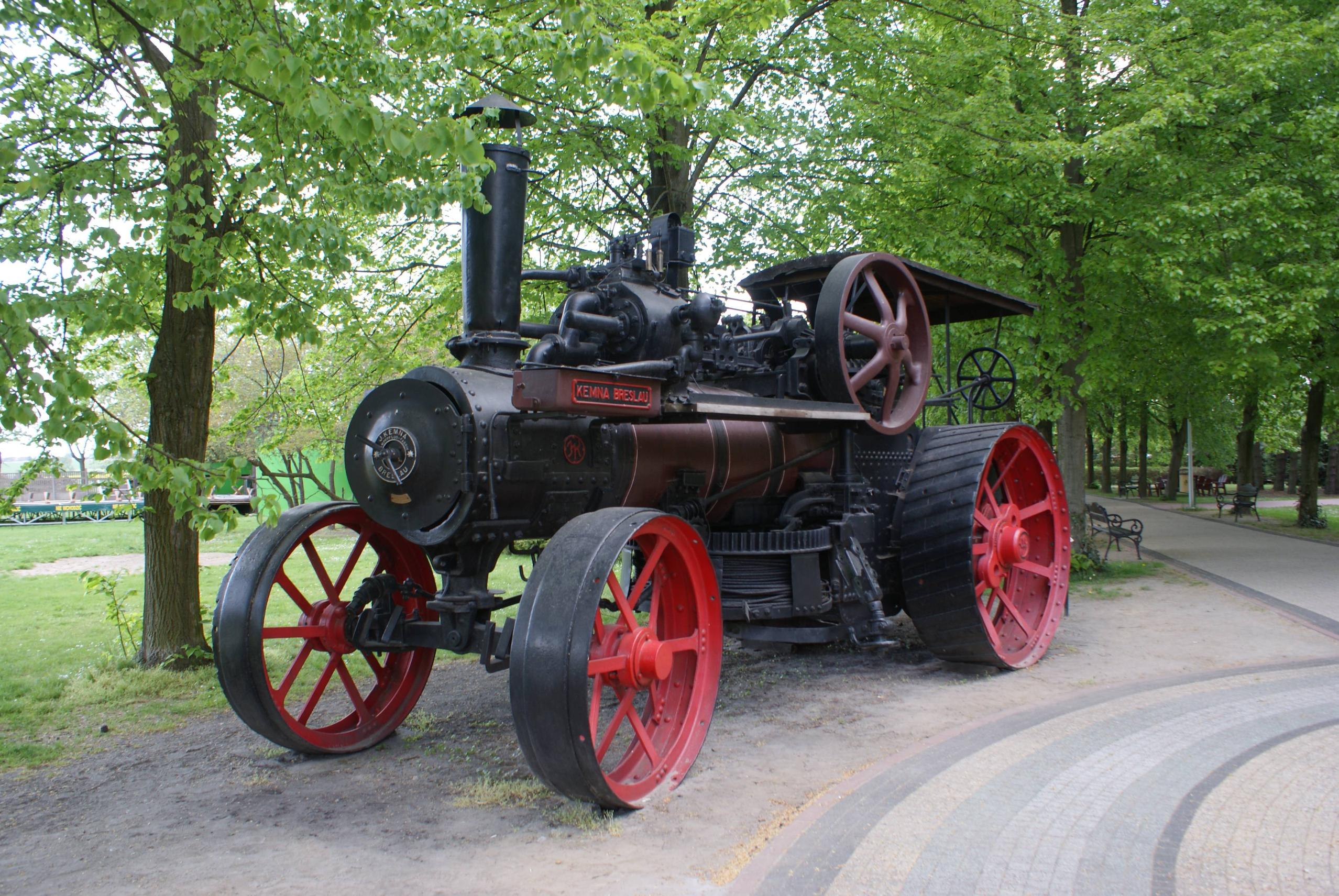
You can see in the picture the boiler is taking the load of the machine. There is no additional chassis.
That's less frame than a Ducati has between the front and rear wheels.
Without speaking to the wisdom of stressing batteries mechanically, the idea of using drivetrain components as structural members of a vehicle is as old as self-propelled vehicles.
Hell, even a chariot sees the horse taking a part of the vehicle load.
Merely "using drivetrain components as structural members" is not a monocoque, but it's a start.
You're correct on the chariot.
A monocoque incorporates ALL components as stressed members so even a classic Lotus Esprit would fail that strict definition given that both hood and trunk are free-floating cantilevers, but point taken.
>You do not want the stressed members of any structure being a salient contributor to its power-train. Not related, see mammalian, reptile, fish, and insect physiologies.
A steam traction engine is certainly at a different level to an F1 car, in both performance and engineering.
On the other hand, I think adding dynamic load to a steam boiler is riskier than doing so to an internal combustion engine.


Mountain lions are avoidant at all times unless it's a mother with cubs and even then they'll let you know well in advance.
Otherwise, just normal conversation, your smell with even a light breeze, and the vibrations on-trail will alert all animals to your presence.
In other words, the "trail music" theory is bullshit. They just want to listen to their music.
reply